
Okay, so check this out—I’ve been messing with hardware wallets for years. Really. Some of them feel like a bulky relic, and others are too fussy for day-to-day use. Wow! Smart-card devices changed that for me. They sit in your pocket like a bank card, tap at terminals, and keep the private keys offline. My instinct said this would be gimmicky at first, but then I actually used one and—whoa—things clicked.
At a glance, contactless crypto wallets solve three pain points at once: convenience, physical form factor, and security. Shortcomings still exist, sure. But for people who want something simple and durable, a smart-card approach is neat. Here’s what I noticed after weeks of running live transactions, storing multiple assets, and intentionally trying to break my setup (I know, nerdy). The patterns are obvious. The details are worth the read.
Contactless payments: real-world usability
Tap to pay is mundane but powerful. Seriously?
Try paying for coffee with a phone that’s dead. Then try tapping a battery-free card-like device. Big difference. Contactless smart-card wallets allow quick payments at NFC-enabled point-of-sale systems without exposing private keys to the phone or cloud. That’s the whole point—simplicity married with separation.
On one hand, NFC payments are widely supported in the US and Europe. On the other, some terminals still fumble with card emulation modes and odd firmware. Initially I thought every merchant would accept it, but then realized compatibility varies. Actually, wait—let me rephrase that: in practice, most places are fine, though small vendors sometimes need coaxing.
Here’s a practical note: you don’t need to dig through an app every time. That lowers friction. My coffee-run latency dropped from an awkward 40 seconds to under 10. There’s momentum to that; people underestimate how often they abandon a crypto payment because it’s clumsy. The faster it feels, the more you’ll use it. And that matters for adoption.
Private keys protection — the hard guarantee
Hardware security is not a slogan. It’s a technical posture.
Smart-card wallets keep the private keys inside a secure element, isolated from the phone’s OS and the web. That separation reduces attack surface dramatically. My gut felt safer immediately when I realized I could sign transactions without keys ever touching a phone. Something about that is calming.
There are nuances, though. A secure element needs robust firmware, and supply-chain integrity matters. On paper, a smart card with a certified secure chip is solid. In reality, you should verify vendor practices and reviews. I’ll be honest—I’m biased toward solutions that publish audits and have visible security processes. This part bugs me when vendors stay vague.
Also, think about recovery strategy. You get a seed or recovery method when setting up a cold wallet. With smart cards, some vendors offer multi-card setups or third-party recovery. That changes threat models. If one card is lost, can you recover? If you use multiple cards, are they single points of failure or redundancies? These are operational questions, not theoretical ones.
Multi-currency support — flexibility and limits
Most people want more than one token. Me included.
Smart-card wallets increasingly support many chains: Bitcoin, Ethereum, EVM chains, and various tokens. Some even do Solana, Tezos, and the rest. That’s huge because it means your single physical device can manage a diversified portfolio without juggling multiple apps or dongles.
Though actually, there’s a trade-off: breadth versus depth. Supporting many assets is great, but integration quality varies. Transaction UX, fee estimation, and token metadata can feel half-finished for lesser-known chains. On the other hand, mainstream coins work very well. Initially I thought “oh perfect”—but then I tried signing a complex DeFi operation and it reminded me how varied blockchain UX still is.
Look for wallets that push firmware updates and maintain active development. If the vendor is quiet for a year, expect some chains to fall behind. That’s not a failure—it’s reality. Crypto evolves fast, and hardware vendors must commit to long-term support. I’m not 100% sure every provider will keep up, but the ones with active communities usually do.
Where the tangem wallet fits in
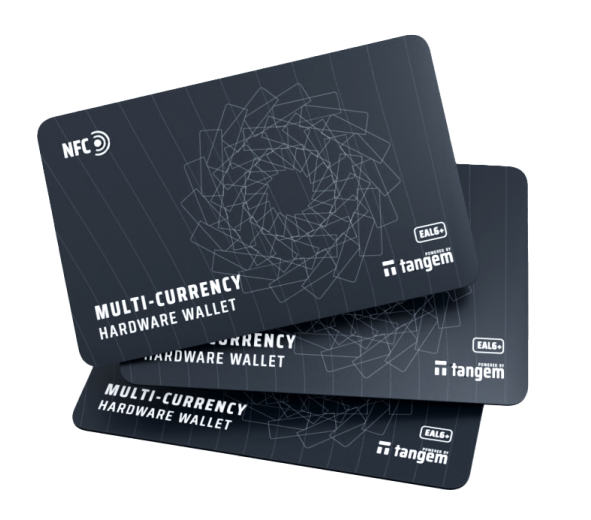
Okay, I used a smart-card product that felt like a bridge between a bank card and a seed vault. The tangem wallet is an example of that design philosophy—minimal UI, physical form factor, and NFC-first UX. No cables. No tedious menus. Just tap and authorize. For someone who values simplicity, that’s attractive.
That said, it’s not magic. The tangem wallet model emphasizes secure elements and offline key storage, but you still need to be disciplined about backup and verification. If you drop the card in a storm drain, recovery becomes your top priority. Wrap that in a mantra: use multi-card backups or robust paper/metal backups if you care about long-term preservation.
FAQ
Is a contactless smart-card wallet as secure as a Ledger or Trezor?
Short answer: it can be. Long answer: security depends on the chipset, firmware, supply chain, and vendor transparency. Ledgers and Trezors have different architectures and open-source stacks; smart-card devices rely heavily on secure elements and closed firmware. Both approaches have pros and cons. Evaluate audits, certifications, and community trust.
Can I use one smart-card wallet for multiple currencies?
Yes. Most modern smart-card wallets support multiple chains. But check which tokens are supported natively and whether the wallet’s companion app handles complex transactions like contract interactions. For mainstream transfers it’s usually seamless; for advanced DeFi moves, test first.
What happens if I lose the card?
That depends on your recovery setup. If you stored the seed or used a multi-card backup, you can recover. If not, loss may mean permanent access loss. Plan for redundancy. (Oh, and by the way… buy a backup.)
Alright—final thought. I like smart-card wallets because they lower friction without giving up a lot on security. Hmm… initially I resisted the form factor, though actually the more I used one, the more it felt like the right compromise for everyday crypto. If you’re someone who wants to spend or move crypto without fuss, give the smart-card approach a serious look. You’ll appreciate the tap, the quiet security, and the pocket-ready convenience. Not everything is solved—nothing ever is—but this is one of those small, practical leaps that actually changes behavior.